
Investigation of Learjet Crash Dynamics
2 min Machine translated
2 min Machine translated
Où ont fini les moteurs du Learjet et sa queue ?
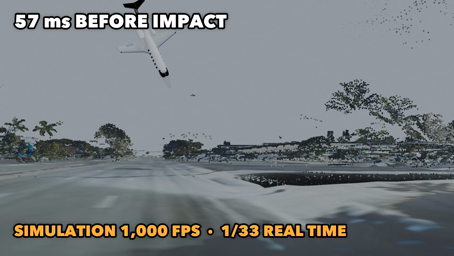
À 640 nœuds, tout s'enfonce dans le sol en une soixantaine de millisecondes, plus vite qu'un clignement d'œil.
L'image B de la caméra embarquée correspond à la simulation.
Bien plus faible que le sol, la structure s'écrase à la surface, et le crasement remonte le long de la cellule à presque toute la vitesse.
À l'image C, la partie avant a disparu. L'empennage est encore à dix mètres de haut.
À 30 millisecondes, le caisson central, le carburant et le train arrivent, et la force atteint un pic proche de 120 méganeutons.
Les moteurs suivent à 33 et 39 millisecondes, puis la queue, encore à environ 500 nœuds.
À la fin, un cratère d'environ 16 mètres sur 8 et trois de profondeur, avec la majeure partie de la structure et des morceaux de moins d'un demi-mètre.
Les moteurs sont les parties les plus denses. Leurs ailettes se détachent.
Les noyaux continuent leur course. Une estimation standard de pénétration les situe à deux à quatre mètres de profondeur, sous la nappe phréatique, où ils se compactent.
Un moteur de deux mètres finit par mesurer entre un demi- mètre et un mètre vingt de long, soit entre un quart et la moitié de sa longueur.
L’ailette se trouve presque certainement dans le cratère, près de la surface.
Le stabilisateur reste une inconnue. S’il s’est détaché en vol, il a dérivé.
Avec la plupart des vents, il atterrit hors du champ de débris, jusqu’à douze miles plus loin. Un fort vent du nord-est pourrait le ramener en arrière.
Ce sont donc ses raccords, et non son emplacement, qui permettront de le dater.
Si vous trouvez une pièce, laissez-la là où elle se trouve et signalez-la.
End of transcript · 296 words · machine translated
Where did the Learjet's engines and tail end up?
At six hundred and forty knots, it's all in the ground in about sixty milliseconds, faster than a blink.
Dashcam frame B lines up with the simulation.
Far weaker than the ground, the structure crushes at the surface, and the crush runs up the airframe at nearly full speed.
Frame C, the nose section is gone. The fin is still ten meters up.
At thirty milliseconds, the wing box, fuel, and gear arrive, and the force peaks near a hundred and twenty meganewtons.
The engines follow at thirty-three and thirty-nine milliseconds, then the tail, still at about five hundred knots.
The end state, a crater about sixteen by eight meters and three deep, with most of the structure and pieces under half a meter.
The engines are the densest parts. Their fans break away.
The cores keep going. A standard penetration estimate puts them two to four meters down, below the water table, and they compact.
A two-meter engine ends up between half a meter and one point two meters long, a quarter to half its length.
The fin is almost certainly in the crater, nearest the top.
The stabilizer is the open question. If it came off in flight, it drifted.
In most winds, it lands outside the debris field, up to twelve miles away. A strong northeast wind could carry it back.
So its fittings, not its location, will date it.
If you find a part, leave it where it is and report it.
 1:56 Pentagon's New Doomsday War Plans
 2:22 Learjet Crash Analysis and Reconstruction
 2:52 Political Conflict in a Sci-Fi Setting
 2:34 Discussion on Hugs and Consent
 2:28 Prayer for Breaking Curses
 0:29 Political Deal and Stardom
 2:29 Rap Battle Featuring MMA References
 1:05 Concerns About Sunscreen Safety
 1:02 Claims of JFK Jr. Being Alive
 2:16 Controversial Claims About Israel's Nuclear Program
 1:10 Discussion on Military Operations and War Plans
 1:37 Impact of CO2 on Health and Space
 iPhone app Translate videos on your iPhone Paste a TikTok, Instagram or X link, add subtitles in your language and save the video to Photos.

TranslateMom transcribes and translates videos from X, TikTok, YouTube and Instagram. Paste a link and you get a page like this one, in your language.